

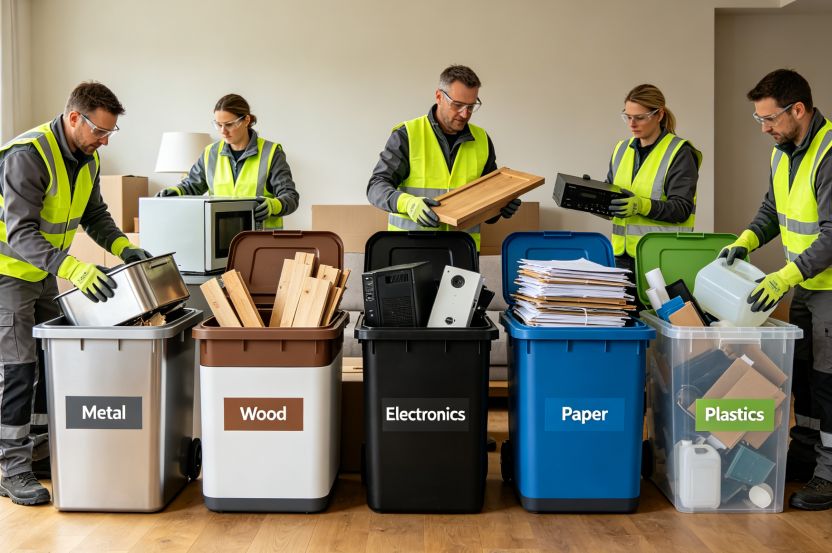
The European Environment Agency reports that improving waste separation and material recovery remains one of the most effective ways to reduce landfill use, conserve natural resources, and support a circular economy across Europe. These principles are especially important during property clearance projects, where large volumes of mixed household materials must be sorted efficiently. Companies that provide estate clearance or verlassenschaft entrümpeln often encounter furniture, electronics, metals, textiles, wood, paper, plastics, and hazardous items that require different handling procedures to maximize recycling and ensure compliance with Austrian waste regulations.
Why Scientific Waste Sorting Matters
Property clearance involves much more than removing unwanted belongings from a building. Every object contains materials with unique physical and chemical properties that determine how they should be processed after collection.
The Austrian Federal Ministry for Climate Action, Environment, Energy, Mobility, Innovation and Technology (BMK) explains that separating waste correctly helps recover valuable raw materials while reducing environmental pollution. Research shows that effective sorting minimizes contamination, allowing recyclable materials to remain suitable for manufacturing instead of being discarded.
This scientific approach begins at the collection stage. Workers evaluate each item based on composition, condition, and recycling potential. Materials that appear similar may require completely different disposal methods because of coatings, adhesives, electronic components, or hazardous substances.
Understanding Material Recovery
Material recovery focuses on extracting reusable resources from discarded products. Instead of viewing waste as something without value, modern recycling systems recognize that many materials can enter new production cycles.
The Organisation for Economic Co-operation and Development (OECD) notes that recovering secondary raw materials reduces dependence on newly extracted natural resources while lowering greenhouse gas emissions associated with manufacturing.
Several common materials recovered during Austrian property clearance projects include:
- Steel and aluminum for metal manufacturing.
- Untreated wood for recycling or energy recovery.
- Glass that can be melted and reused repeatedly.
- Paper and cardboard processed into new paper products.
- Certain plastics sorted according to polymer type.
- Electronic equipment containing valuable metals such as copper and precious metals.
Each category follows different recovery pathways because every material behaves differently under heat, pressure, or chemical treatment.
The Role of Physical Science in Waste Separation
Many recycling facilities rely on scientific principles from physics to separate mixed materials efficiently after collection.
Magnets remove ferrous metals such as steel. Eddy current separators use electromagnetic fields to separate non-ferrous metals like aluminum. Optical sorting systems identify plastics using infrared spectroscopy, while air classifiers separate lighter materials from heavier ones using controlled airflow.
The International Solid Waste Association (ISWA) explains that combining automated technologies with manual inspection increases sorting accuracy while improving recovery rates.
These technologies become especially valuable after residential cleanouts because household waste often contains a wide variety of materials mixed together.
Chemistry Helps Identify Safe Recycling Methods
Chemistry plays an equally important role during waste management.
Many products contain additives, coatings, adhesives, batteries, paints, or cleaning chemicals that require specialized handling. Mixing incompatible substances may create environmental risks or reduce the quality of recyclable materials. Understanding the chemical transformation during surface cleaning also helps explain why different contaminants require specific cleaning methods before certain materials can be safely reused or recycled.
The European Chemicals Agency (ECHA) emphasizes that identifying hazardous substances helps protect workers, recycling facilities, and surrounding ecosystems.
For example, electronic devices may contain lithium batteries, lead, mercury, or flame retardants. Proper separation prevents contamination while allowing valuable metals to be recovered safely.
Austria’s Waste Management Standards
Austria has developed one of Europe’s well-established waste management systems through a combination of legislation, public participation, and recycling infrastructure.
Eurostat data indicates that Austria consistently ranks among European countries with high municipal recycling rates. National regulations encourage proper segregation of recyclable materials while reducing landfill dependence through recovery and reuse initiatives.
Property clearance providers working within these regulations must carefully classify collected materials before transporting them to authorized recycling centers, reuse organizations, or disposal facilities.
This organized process supports environmental protection while ensuring compliance with national waste management requirements.
Manual Expertise Still Matters
Advanced equipment cannot replace human judgment during property clearance.
Experienced workers identify reusable furniture, antiques, collectibles, and repairable household items that automated systems cannot easily recognize. Human inspection also helps separate hazardous materials before they enter recycling streams.
The United Nations Environment Programme (UNEP) notes that improving reuse alongside recycling extends product life cycles and reduces overall waste generation.
Whenever practical, reusable belongings may be donated, refurbished, or sold before remaining materials proceed to recycling facilities. This approach supports resource efficiency while reducing unnecessary disposal.
Environmental Benefits of Better Sorting
Careful waste separation produces measurable environmental improvements throughout the recycling process.
Research published by The International Energy Agency (IEA) indicates that manufacturing products from recycled metals generally requires significantly less energy than producing the same materials from newly mined ores. Similar environmental advantages exist for recycled paper, glass, and several plastic products.
Higher-quality sorting also reduces contamination. When recyclable materials remain clean, manufacturers can process them more efficiently, resulting in better-quality recycled products.
During estate clearances, household cleanouts, and large residential decluttering projects, systematic material classification contributes to these broader sustainability goals.
Technology Continues to Improve Recycling Efficiency
Modern recycling facilities continue adopting digital technologies that improve waste recovery.
Artificial intelligence supports automated object recognition, while robotic sorting systems increase processing speed without compromising accuracy. Machine learning algorithms help identify recyclable materials more consistently as facilities handle growing waste volumes.
The World Economic Forum highlights that digital technologies are helping strengthen circular economy initiatives by improving material tracking and resource recovery throughout waste management systems.
Although automation continues to expand, successful property clearance still depends on careful planning, accurate classification, responsible transportation, and cooperation between collection teams and recycling facilities.
Conclusion
Modern property clearance combines environmental science, engineering, chemistry, and practical experience to manage waste responsibly. Scientific sorting methods help identify recyclable materials, recover valuable resources, protect public health, and reduce unnecessary landfill disposal.
Austria’s established waste management framework demonstrates how organized collection, careful material separation, and advanced recycling technologies can improve environmental outcomes. As recycling methods continue evolving, estate clearances and residential cleanouts increasingly support resource conservation by directing recoverable materials back into productive use instead of treating them simply as waste.
Understanding the science behind these processes allows property owners to appreciate why proper material separation remains an essential part of responsible clearance and sustainable waste management.


